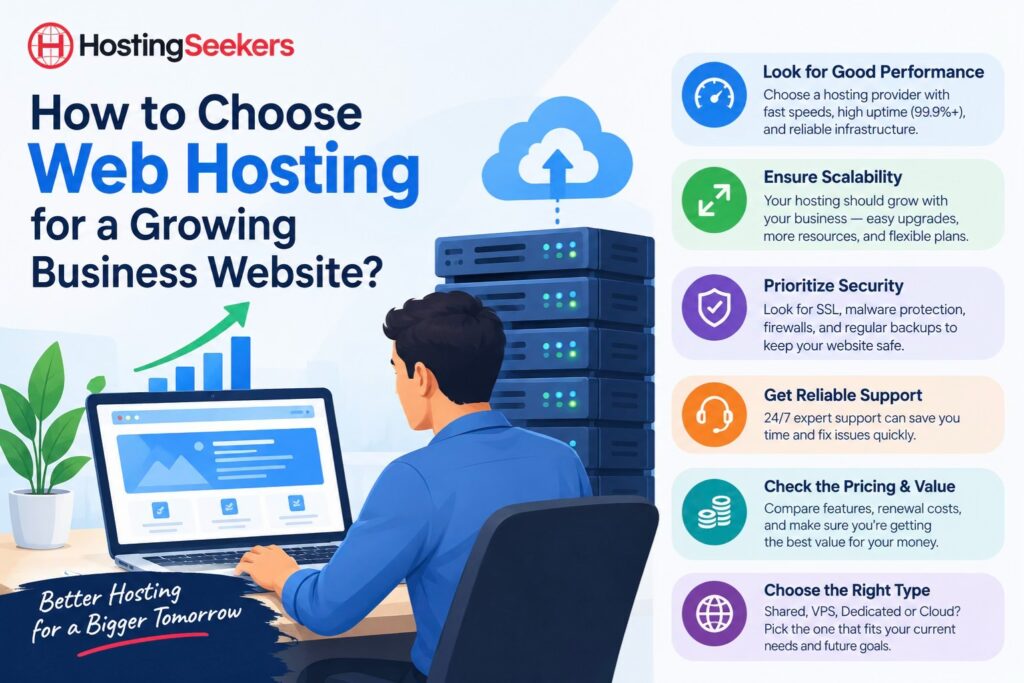
How to Choose Web Hosting for a Growing Business Website?
Getting your own business website up and running is quite exciting for any entrepreneur because this is the time when you can attract customers, get them interested in your services and let them buy something online. However, as your business progresses, you need to ensure that your website evolves too, to be able to handle the ever-growing traffic and needs.
For instance, the hosting plan you used for hundreds of users per day might not suffice for thousands. Slow loading of pages, failed transactions and possible down times will not please anyone who wants to buy your products.
That is why choosing a hosting plan is never about picking the cheapest one or the one that provides maximum amount of disk space. On the contrary, you should find a plan that will work for you now but will allow you to grow further.
Why Do You Need Web Hosting for Your Company?
The web host that you have chosen determines the availability of your website on the internet. It influences such things as the speed of loading, reliability, and performance at increasing loads. In case you are expanding, these aspects have a direct impact on the user experience.
Think about how many clients may leave your online shop without purchasing any goods because of sudden downtime caused by the inability of the hosting server to cope with the load.
The same concerns many SaaS websites, customer portals, and other service-oriented websites. With the right hosting services, you can make sure of your website stability now and in the future.
Understand the Different Types of Web Hosting
Before making comparisons between various hosts, one has to be familiar with the available web hosting environments since each environment presents a certain level of resource provision and flexibility.
Shared Web Hosting
In shared web hosting environment, several websites run on a single server by using the server’s resources. It is recommended for small business websites, blogs, and startup companies that require moderate traffic capacity. But with increased traffic capacity, it becomes a bottleneck in terms of resource allocation.
Virtual Private Server (VPS) Web Hosting
In the virtual private server web hosting environment, the physical server is partitioned to provide isolated virtual environments for customers who will get allocated resources.
Dedicated Server Hosting
With dedicated hosting, one has the ability to use the whole physical server to himself/herself. In contrast with shared hosting, one is able to customize server resources and software to suit his/her needs. This could be appropriate for high-traffic sites, complex business applications, and workloads where more infrastructure control is required.
Firms looking to explore further their hosting possibilities will be able to look into the best dedicated server hosting services offered by different companies considering performance needs, support, and available resources.
Cloud Hosting
The cloud hosting technology makes use of virtual computing resources that can be allocated and managed depending on the needs of the application in question. Depending on the technology architecture, one is able to get advantages of flexible resource allocation, distributed infrastructure, and increased availability.
Key Factors to Consider When Choosing Web Hosting
The next step is evaluating whether a hosting service can support your website as business requirements evolve.
1. Web Site Performance and Load Time
Nobody likes waiting for a web site to load when they are making a purchase or using other important services. There are multiple reasons why website performance is not always good: server response time, application speed, caching, and network performance being among those. Choose a host to focus on:
- Storage Type: SSD and NVMe storage solutions have better access speeds compared to HDDs.
- Hardware Resources: Enough CPU and RAM can help the application to process requests fast.
- Proximity of Server: Closer servers will ensure lower network delay.
- Caching and CDN Capabilities: Those help with delivery of website content.
However, keep in mind that even upgrading your host might not solve all of your performance problems.
2. Scalability for Increased Traffic
A company’s growth is not necessarily incremental; it may suddenly come in through a marketing campaign or product release. Your hosting solution needs to be able to adapt to this type of situation. Asking yourself whether you can scale your CPU, RAM, disk space, or bandwidth without difficult migrations should precede selecting any plan.
You should also consider whether this scaling causes downtime and how fast resources are scaled up. This is especially true for SaaS applications since increased users imply increased demands on database servers and application servers.
3. Security and Data Protection
Your company will likely need to provide your website with increasing amounts of customer data, account information, and payments transactions as it grows. Hosting security will become an essential aspect to consider. Hosts that offer:
- SSL/TLS certificates to establish secure connections
- Firewalls and DDoS protection
- Security updates and monitoring of servers
- Automated backups and data recovery procedures
- Control access and secure authentication
It will also be important to know the division of responsibility for security issues between you and the hosting provider.
For example, a managed hosting plan might include maintaining servers, whereas an unmanaged hosting plan will involve more technical work on your side.
4. Uptime and Hosting Reliability
Think about how your customers might try to schedule their service through your website and not be able to because the website isn’t working. In fact, even a couple of hours without access to your website can disturb the course of your business and cast doubts about your reliability on your customers’ part.
Therefore, consider the uptime service-level agreement (SLA) of the hosting, their maintenance process, and their incident handling methods. Consider not only the percentage uptime, but the terms of service included and excluded from the SLA.
5. Technical Support and Server Administration
It is unlikely that your technical problems will arise in convenient periods of time. A misconfigured server, failed updates, and outages are particularly dangerous when you use your website for conducting business.
Find out the type of support offered by the hosting company, as well as the channels available. But even more important is to find out the type of support offered.
Is it support for the server level only, or your hosting company will help you configure applications, create and restore backups, migrate websites and so on? If your business lacks the technical support team, managed hosting will be helpful in reducing these problems.
6. Pricing and Future Expenses
Low-cost pricing is tempting, but it might not tell the full story about the actual hosting expense. Make sure that you know what will be the renewal pricing and any additional fees for such services as backup, storage, security services, control panel, technical support, etc.
Also, consider what will be the cost of migration if your business needs it in the future. Instead of choosing the lowest cost hosting, think about its value for your business.
How to Decide on the Final Hosting Option?
In order to choose the hosting option, you need to assess the needs of your website currently and the possibilities of further development. Here are some recommendations for making this decision:
- Assess the Visitors of Your Website: Determine the amount of visitors on your website now and the growth in traffic in order to understand how much server resources your website might require.
- Define the Technical Needs of Your Website: Review your website’s software requirements, storage space, bandwidth, applications, and more before choosing a hosting environment.
- Create a Budget: Compare the prices on different types of hosting plans, prices on renewing, and additional expenses to select a good deal and avoid unnecessary spending.
- Pick the Right Hosting Solution: If you have a small website, then you probably should go for shared hosting, but larger and growing eCommerce sites will require VPS or cloud hosting. The choice of dedicated hosting may be considered as well.
Conclusion
Web hosting for a growing business does not consist of choosing the best possible server. Rather, it involves balancing performance, reliability, security, and costs of a website.
Start from the real needs of your website, take into account the technical capabilities of the provider, and think about the possibility of scaling later. After all, your website is supposed to assist you in your business development, not bring about new problems in the case of increasing traffic.
Frequently Asked Questions
What hosting is best for the growing business?
This will depend on your traffic and your requirements as well as the budget that you have. The best option will be the one that will suit your website. VPS and cloud hosting will be great options for a growing business.
When should I get upgraded hosting?
If you notice slow loading of your website, frequent resource limitations and high traffic that your existing hosting does not support anymore, then it’s time to upgrade your hosting.
Can I use shared hosting for business?
Shared hosting will be suitable for a small business website. But as your business will grow, you might need to upgrade to another type of hosting.
Difference between VPS and dedicated hosting.
VPS hosting will provide you with allocated resources in the form of a virtual server, while the dedicated one will give you the entire server.
What should I expect from a web hosting company?
Uptime, security, customer support, scalable hosting packages, and pricing are all important to consider.
What is the cost of web hosting services for businesses?
Web hosting services vary in cost based on the kind of hosting, server, and hosting company. Shared hosting services tend to be cheaper than VPS, cloud, and dedicated web hosting.
Is it possible to change web hosting companies later?
It is possible to switch your website to a different web hosting company. This requires moving your website files, database, and domain name.