UX vs Marketing: What Really Drives User Engagement?
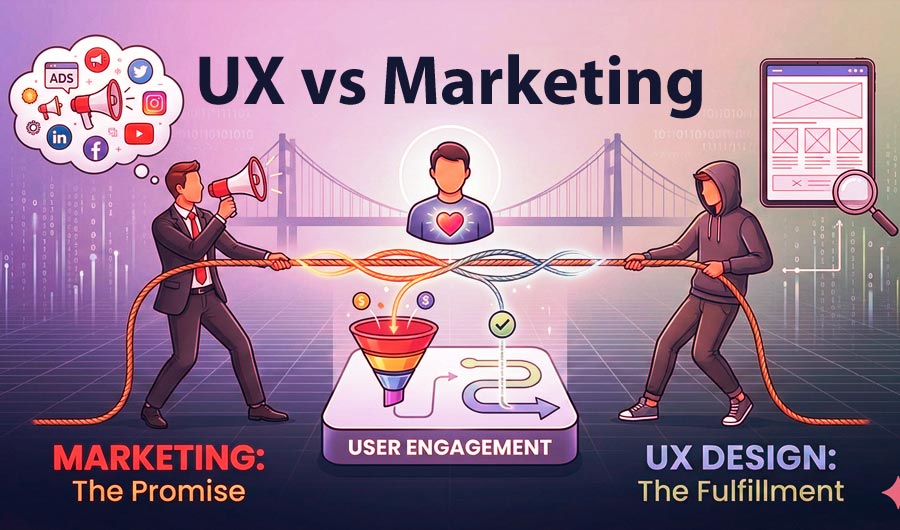
In the high-ticket world of digital growth, there is going an outstanding tug-of-war between the areas of Marketing and User Experience (UX). Marketers are often seen as the charismatic “hype-men” of a brand, tasked with capturing attention of users and generating clicks through compelling storytelling and psychological tricks. Other the other hand, UX designers are the compassionate architects, focused on building a seamless journey for user’s needs are met without friction.
But if we see the digital landscape of 2026, a basic fundamental question carries on: What actually drives user engagement? Is it just a flashy campaign that seduces the user in, or the intuitive interface that makes users to stay? But the truth is different, engagement is no longer a solo performance. It is a symphony.
While marketing sets the stage and builds the anticipation for marketing, UX ensures the performance is worth the ticket price. A great marketing strategy is mixes the two, businesses can’t risk creating a “leaky funnel” — spending thousands to acquire users who vanish the moment they encounter a clunky checkout process.
Marketing: The Art of the Promise
Marketing is fundamentally about the promises. This promise has evolved from broad broadcasting to hyper-personalized AI-driven narratives. Now modern marketing doesn’t just ask for users attention; it predicts intent. By leveraging behavioral data, marketers can serve an ads, when a user’s search history suggests they are suffering with a certain problem. This is the “hook”. It creates an immediate emotional connection and a sense of urgency.
However, marketing’s greatest strength “convincing” is also its greatest risk. When the “promise” of marketing outpaces the reality of the product, users feel misled. We’ve all already experienced the frustration of clicking a beautifully designed social media ad only to be dropped into a chaotic, slow-loading landing page that looks nothing like the brand we just saw. This is where engagement dies.
In today’s market, the metrics of success in digital marketing have shifted. Marketers are moving away from “vanity metrics” like likes, views and impressions, focusing instead on Customer Lifetime Value (LTV) and Customer Acquisition Cost (CAC). They understand that a high conversion rate on a low-quality lead is a net negative for the company. The marketing goal is to find the right user, not just any user.
UX: The Fulfillment of the Dream
If marketing is the promise, UX is the fulfillment. This is where UI and UX design becomes the silent pillar of business growth. A well-crafted user experience (UX) doesn’t just look “pretty”; it removes the logical load from the user end and allowing them to achieve their goals with the least amount of resistance possible.
In 2026, UX is no longer just about beautiful screens. It has expanded into multimodal interfaces — incorporating voice, gesture-based controls, and even haptic feedback. For instance, a user can start any task via a voice command on their smart glasses and finish it with a simple swipe on their phone.
The ROI of Good UX
The financial argument for UX is stronger than ever. Industry data consistently shows that for every $1 invested in UX, there is a return of up to $100. This 9,900% ROI comes from:
- Reduced Support Costs: Clearer interfaces mean fewer confused users calling help centers.
- Increased Conversion: Small tweaks in micro-interactions can boost completion rates by over 80%.
- Enhanced Loyalty: Users don’t switch from a product that “just works”.
“Design is not just what it looks like and feels like. Design is how it works.” — Steve Jobs
The Friction Point: When Goals Clash
Despite their common goal of “growth”, Marketing and UX often clash on the tactical level. Marketing might want to implement a “Dark Pattern“— such as a countdown timer that creates fake urgency and scarcity or an “exit-intent” pop-up that blocks the user from leaving the website. These tactics often drive short-term spikes in conversion, which looks great on a weekly marketing report.
However, UX designers see the long-term damage. These “friction points” never build the trust. A user who feels “tricked” into a subscription might stay for a month, but they will leave after a month and, worse, tell fifteen other people about their bad experience or might be drop bad reviews. Digital Trust is the most valuable assets, if it gone, nearly impossible to earn back.
Synergistic Engagement: The 2026 Engagement Sweet Spot
So, what really drives engagement? The answer is simple, synergy. The most successful digital products of digital era. You don’t need to treat Marketing and UX as separate silos; they practice Growth Design. This is an integrated approach, where marketing insights tell design choices, and design principles are used to make marketing more effective.
For example, consider Hyper-Personalized Onboarding. Instead of a generic “Welcome” tour, a growth-oriented product uses marketing data (how the user found the site, what they searched for) to analyze the first-time user experience. If a user clicked an ad for “Advanced Data Visualization,” the UX should immediately show a specific tools rather than making the user dig through a basic tutorial.
Modern Engagement Drivers
To truly drive engagement in the current landscape, teams must focus on these four pillars:
- 1. Predictive Design: Using AI to anticipate the user’s next move. If a user always checks their “Weekly Report” on Monday mornings, the interface should surface that report on the home screen at 9:00 AM.
- 2. Micro-Interactions: Those small animations—a subtle vibration when a payment is successful or a satisfying “pop” when a task is completed. These create “joyful friction” that makes the product feel alive.
- 3. Ethical Transparency: Being upfront about data usage. In 2026, users are savvy. They appreciate brands that explain why they need a certain permission, turning a privacy hurdle into a trust-building exercise.
- 4. Inclusive Accessibility: Engagement isn’t just for the able-bodied. High-engagement products are built with high-contrast modes, screen-reader compatibility, and voice-first options as standard features, not afterthoughts.
The Role of UI and UX in the AI Era
As we entered into 2026, Artificial Intelligence (A.I) is rewriting the rules of user interaction. We are moving away from “fixed interfaces” toward Generative UI. This means the layout and design of an app might literally change in real-time based on the user’s intent.
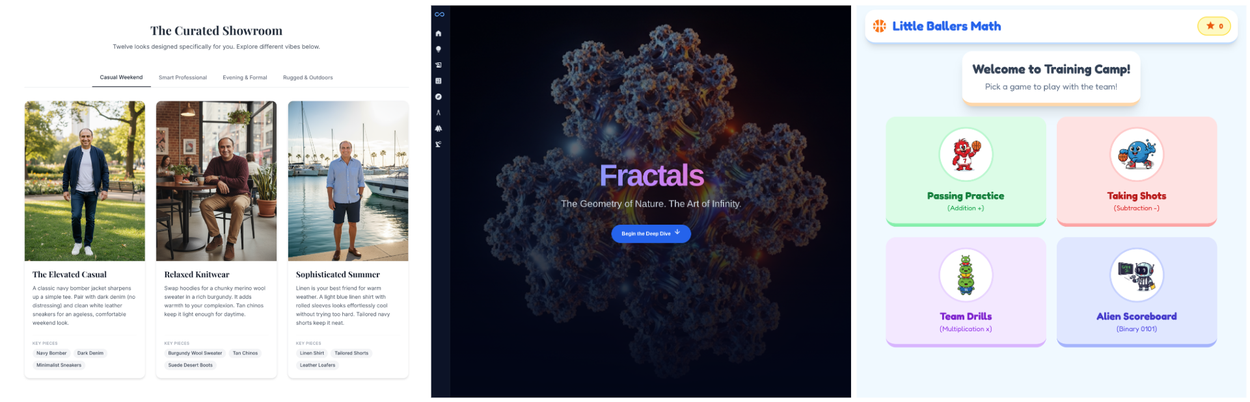
The “ad” becomes the “interface.” If you search for a flight, the marketing result isn’t just a link to a booking site; it’s a functional widget that lets you select a seat and pay right there in the search results. This level of utility is the ultimate driver of engagement. It’s no longer about “content” or “usability” alone—it’s about total context.
Conclusion: A Shared Responsibility
User engagement is not a prize to be won by a marketing team or UX team, it is a metric of how well a company can understands and serves its audience. Marketing provides the spark of interest, but UX provides the fuel that keeps the fire burning in digital marketing. When they work in isolation, you get a product that is either “all hype and no substance” or “a masterpiece that nobody knows exists“.
To dominate the digital market in 2026, you must align your brand’s promise with your product’s performance. You need stop spending more on ads or on beautiful design. Instead, ask how your design can make your ads more truthful or more helpful, and how your marketing can make your user journey more rewarding. That is the only way to drive engagement that lasts.
Would you like me to create a customized UX audit checklist to help you identify the friction points in your current user journey?

- UX vs Marketing: What Really Drives User Engagement?

- Why Custom eCommerce Website Development Beats Templates Every Time
- The Future of Enterprise Payables Billing: Making Client Management Easier with Automated Invoice Processing
- How to Choose the Right Fulfillment Partner for Your DTC Brand
- On-Demand Apps for Every Industry: The Ultimate Guide